What If We Turned Our Overthinking Into Little Characters Instead of Fighting It?
On anxiety, creative self-care, and why sometimes a silly little doodle can help us understand the thoughts running around in our heads.
Have you ever been overthinking so much that your brain feels like it’s hosting an entire conversation without your permission?
Because, same.
One thought is worrying about something that might happen tomorrow.
Another is reminding you about something embarrassing you did five years ago.
Another is questioning whether you’re doing enough with your life.
And another has already imagined approximately 47 different worst-case scenarios that haven’t even happened yet.
Meanwhile, you’re just trying to enjoy a peaceful afternoon.
Excuse me, brain?
Can we please have five minutes of quiet?
Apparently not.
As someone who struggles with anxiety, overthinking, and a mind that doesn’t always know when to slow down, I’ve spent a lot of time trying to figure out how to manage my thoughts.
And if you’ve ever tried telling yourself to just stop thinking about something, you probably know how well that works.
Spoiler alert.
It usually doesn’t.
Sometimes the more I try to push a thought away, the louder it seems to become.
But lately, I’ve been exploring a different idea through my creativity.
What if, instead of fighting our thoughts, we turned them into characters?
What if your anxiety became a nervous little monster?
What if your inner critic became a grumpy creature holding a megaphone?
What if your perfectionism became a tiny bossy critter carrying a clipboard?
And what if your overthinking became an exhausted little raccoon surrounded by seventeen thought bubbles, three unfinished to-do lists, and a coffee it probably doesn’t need?
Honestly, that last one feels suspiciously relatable.
This is the idea behind Turning Thoughts Into Characters, a creative self-expression exercise featured in my Cozy Critters Creative app.
And the best part?
You don’t have to be an artist to try it.
Sometimes Our Thoughts Need Somewhere Else to Go
One thing I’ve learned through my own mental health journey is that keeping everything inside my head can become exhausting.
The worries.
The fears.
The what-ifs.
The constant questioning.
The things I wish I’d said differently.
The things I haven’t done yet.
And the situations my brain has somehow already decided are going to go wrong.
Sometimes it feels like my mind has 50 browser tabs open.
And I can’t figure out which one is playing the music.
I’ve always found comfort in creativity.
Even before I started building my own creative projects and mental wellness resources, art was a way for me to express things I didn’t always know how to explain.
Sometimes I could draw something I couldn’t put into words.
Sometimes writing helped me make sense of what I was feeling.
And sometimes simply coloring or doodling gave my mind something else to focus on.
That’s why I love the idea of turning thoughts into characters.
Instead of letting every worry bounce around inside your head, you’re giving it somewhere to exist outside of your thoughts.
On a piece of paper.
In a sketchbook.
Or inside a digital drawing app.
And sometimes that little bit of distance can help you look at a thought differently.
Doodling Doesn’t Have to Be Serious Art
Can we normalize making art that doesn’t need to be good?
Seriously.
As an artist, I think one of the most freeing things we can do is create something without worrying about whether it looks impressive.
Not everything needs to become a masterpiece.
Not every drawing needs to be shared online.
Not everything needs to become a product in an Etsy shop.
And not every creative project needs to have a purpose beyond helping us enjoy the moment.
Think about the random doodles we used to make in our school notebooks.
Little flowers.
Hearts.
Stars.
Smiley faces.
Strange creatures.
Random shapes.
Characters that somehow appeared while we were supposed to be paying attention in class.
We weren’t necessarily trying to create professional artwork.
We were just making marks.
And I think there’s something really comforting about that.
When you take away the pressure to create something perfect, art becomes a little less intimidating.
It becomes playful.
Experimental.
Personal.
You can make something weird.
Something messy.
Something completely ridiculous.
And nobody has to approve of it.
Sometimes creativity is about expressing yourself, not impressing someone else.
And that’s exactly the kind of space I wanted to create with Cozy Critters Creative.
Step One: What If Your Worry Was a Little Monster?
Here’s where things get interesting.
Think about one thought that’s been taking up space in your mind lately.
Maybe it’s:
What if I mess something up at work?
What if I’m falling behind in life?
What if people don’t like me?
What if my creative work isn’t good enough?
What if something goes wrong?
Now, instead of trying to answer the thought immediately, imagine it as a little creature.
What would it look like?
Maybe your worry is a fluffy purple monster with enormous eyes.
Maybe your inner critic is a tiny grumpy cat with crossed arms.
Maybe your perfectionism is an overly serious little creature wearing glasses and carrying a clipboard.
Maybe your overthinking is a frantic raccoon wearing mismatched socks and dragging around seventeen emergency backpacks.
You know.
Just in case.
And maybe your anxious thoughts become a whole collection of little characters, each one trying to get your attention at the same time.
Draw whatever comes to mind.
It can be cute.
It can be weird.
It can be completely messy.
It can literally be a circle with two eyes and a worried expression.
This isn’t about drawing ability. It’s about giving your thoughts a shape.
Step Two: Give Your Thought a Personality
Now that you’ve created your little character, let’s give it a voice.
What does it say?
Maybe your worry monster constantly asks:
But what if something goes wrong?
Your perfectionism character might say:
That’s not good enough. Try again.
Your inner critic might say:
Everyone else is doing better than you.
And your overthinking raccoon?
Well, that little guy probably has a lot to say.
What if this happens?
Did you remember that thing from three weeks ago?
What if someone misunderstood what you said?
Should we replay that conversation again?
Also, what are we having for dinner tomorrow?
Exhausting.
But here’s the interesting part.
When you write those thoughts around your character in speech bubbles, you’re creating a little separation between yourself and what your mind is telling you.
Instead of the thought simply existing in your head, you’re looking at it.
You’re observing it.
And maybe you’re starting to recognize that it isn’t automatically a fact.
It’s a thought.
And thoughts aren’t always accurate.
Step Three: Talk Back to Your Little Critter
Now here’s where we can bring a little self-compassion into the exercise.
Let’s say your worry character says:
Everything is going to go wrong.
Instead of immediately believing that prediction, maybe you respond:
That’s one possibility, but it isn’t the only possibility.
Or maybe your perfectionism character says:
You have to get this exactly right.
And you respond:
I’m allowed to learn. Good enough is still good.
Maybe your inner critic says:
You’re not talented enough.
And you remind it:
I’m still developing my skills, and that doesn’t make my creativity less meaningful.
This is one reason I’ve become interested in incorporating concepts from cognitive behavioral therapy, or CBT, into creative activities.
One useful CBT idea is learning to examine our thoughts rather than automatically treating every thought as the truth.
And sometimes drawing can make that process feel more approachable.
Instead of staring at a blank journal page and trying to explain everything you’re feeling, you can create a little character and have a conversation with it.
You’re not trying to force the character to disappear.
You’re not punishing it for being anxious.
You’re simply practicing a different way of responding.
You can notice a thought without automatically agreeing with everything it says.
And sometimes that’s an important distinction.
Step Four: Make Your Overthinking a Little Ridiculous
Okay, this might be my favorite part.
Make your characters silly.
Give your anxiety monster tiny rain boots.
Put a giant bow on your perfectionism critter.
Give your inner critic a squeaky voice.
Draw your worry monster carrying seventeen emergency backpacks because apparently it’s preparing for every possible disaster in human history.
Maybe your overthinking raccoon needs three coffees, a planner, and a vacation.
Honestly, same.
Why add humor?
Because sometimes imagining a difficult thought in a playful way can change how we relate to it.
The thought might still exist.
The worry might still be there.
But instead of feeling completely consumed by it, you may find yourself looking at it from a little distance.
Instead of thinking:
Everything is going to go wrong.
You might think:
Oh, there’s my little worry creature predicting the future again.
And sometimes that shift can make a thought feel a little less intimidating.
Not every worry will become funny, and serious or distressing thoughts don’t need to be turned into jokes. You can skip the humor whenever it doesn’t feel helpful.
But when it feels right, a little creativity can offer a gentler way to engage with what’s happening inside your mind.
You Are Not Every Thought You Have
This is something I’ve had to remind myself of a lot.
Having a thought doesn’t automatically mean it’s true.
Our minds generate thoughts constantly.
Some are helpful.
Some are realistic.
Some are based on memories.
Some are predictions.
Some come from fear, assumptions, or insecurity.
And some are just random thoughts that pop into our heads without any particular meaning.
When you struggle with anxiety or overthinking, it can be easy to get caught up in thoughts that feel convincing simply because they’re loud or repetitive.
But a thought isn’t automatically a fact.
And it isn’t necessarily a reflection of who you are.
You can think:
I’m going to fail.
Without actually knowing that you’re going to fail.
You can think:
Everyone is judging me.
Without knowing what anyone else is thinking.
And you can think:
I’m not good enough.
Without that thought defining your worth.
This exercise is a creative way to explore that difference.
It invites us to notice what our minds are saying, express it visually, and consider whether there’s another way to look at the situation.
For those who experience persistent or distressing symptoms, creative exercises can complement support, but they’re not a substitute for professional care.
Still, I love the idea that something as simple as a doodle can become a little moment of self-reflection.
Why I Created Cozy Critters Creative
When I started developing my Cozy Critter apps, I knew I wanted them to feel different from traditional wellness tools.
I wanted something cozy.
Creative.
Approachable.
Something that didn’t make taking care of your mental health feel like another overwhelming responsibility.
And as an artist, I wanted to bring creativity into that experience.
That’s where Cozy Critters Creative comes in.
It’s a digital sketchbook-style app built around playful creative exercises, doodling, emotional expression, and exploring thoughts through art.
Not because I believe art can magically solve every mental health struggle.
It can’t.
And not because I think everyone needs to be an artist.
You don’t.
But because creativity has always been an important part of my own journey.
Sometimes drawing helps me slow down.
Sometimes scribbling helps me express frustration.
Sometimes coloring gives my mind somewhere quieter to go.
And sometimes creating a silly little character makes a difficult thought feel a little easier to look at.
I wanted Cozy Critters Creative to encourage that kind of exploration.
No pressure to make something perfect.
No expectations to become a professional artist.
No need to share your work with anyone.
Just a space where you can create for yourself.
Because sometimes the most meaningful artwork isn’t the prettiest thing you’ve ever drawn. It’s the thing that helped you express what you were feeling.
Try It Yourself: Turn a Thought Into a Character
If you’d like to try this exercise, you don’t need anything fancy.
Grab a notebook, a piece of paper, your favorite drawing app, or whatever art supplies you have nearby.
Then try these five little steps.
1. Choose a thought.
Pick a manageable worry, self-critical thought, or feeling that’s been taking up space in your mind.
2. Give it a character.
What would that thought look like as a tiny creature? Is it nervous, dramatic, grumpy, shy, or completely overwhelmed?
3. Add speech bubbles.
Write down a few things the character might say.
4. Respond with kindness.
Imagine what a calmer, more compassionate voice might say back. You don’t need to argue with every thought. Sometimes simply acknowledging it is enough.
5. Add your own creative twist.
Give the character a funny name, a ridiculous hat, tiny shoes, or anything that feels right.
When you’re finished, take a moment to look at what you’ve made.
How do you feel?
Did anything surprise you?
Did you notice a thought you hadn’t really questioned before?
Did the exercise help you express something that was difficult to put into words?
There’s no perfect answer.
And there’s no requirement to feel better immediately.
Sometimes the exercise is simply an opportunity to notice what’s happening inside your mind without judging yourself for it.
This is the prompt I used….
“Create Your Own Mental Health Chibi Companion
AI Art Prompt (Copy & Paste):
Create an adorable, original kawaii chibi character that represents my unique mental health journey, emotional struggles, personality, and inner world.
Transform the emotions and challenges I experience into a cute, comforting, expressive character that feels personal and relatable.
My personal details:
- My mental health condition(s): [Insert conditions or challenges]
- My biggest emotional struggles: [Anxiety, overthinking, depression, burnout, racing thoughts, etc.]
- My personality: [Introverted, sensitive, creative, shy, outgoing, etc.]
- My favorite animal or creature: [Cat, fox, bunny, frog, bear, fantasy creature, etc.]
- My favorite colors: [Insert colors]
- What brings me comfort: [Art, music, books, pets, nature, gaming, etc.]
- A phrase that represents me: [Insert your favorite affirmation or quote]
Character Design:
Give my character oversized expressive eyes, adorable rounded proportions, tiny paws or hands, and a unique outfit that reflects my personality.
Use gentle visual symbolism to represent my emotional experiences, such as floating thought bubbles, tangled scribbles, tiny rain clouds, glowing stars, hearts, or soft shadows.
Balance difficult emotions with comforting details that represent resilience, self-compassion, creativity, and hope.
The character should not be forced to smile. Let their expression reflect the complexity of living with mental health challenges while still being lovable and worthy of kindness.
Art Style:
Soft pastel kawaii aesthetic, super-cute chibi proportions, cozy hand-drawn digital illustration, delicate watercolor textures, gentle lighting, expressive facial features, whimsical details, and a soothing color palette.
Create a polished, original mascot character suitable for stickers, journal pages, mental health awareness artwork, digital collages, and self-care illustrations.
Overall Theme:
“My struggles are part of my story, but they do not define who I am.”
Avoid frightening imagery, harmful stereotypes, and exaggerated depictions of mental illness.
Bonus: Give my character a unique name, a short personality description, and a comforting affirmation that reflects my journey.”
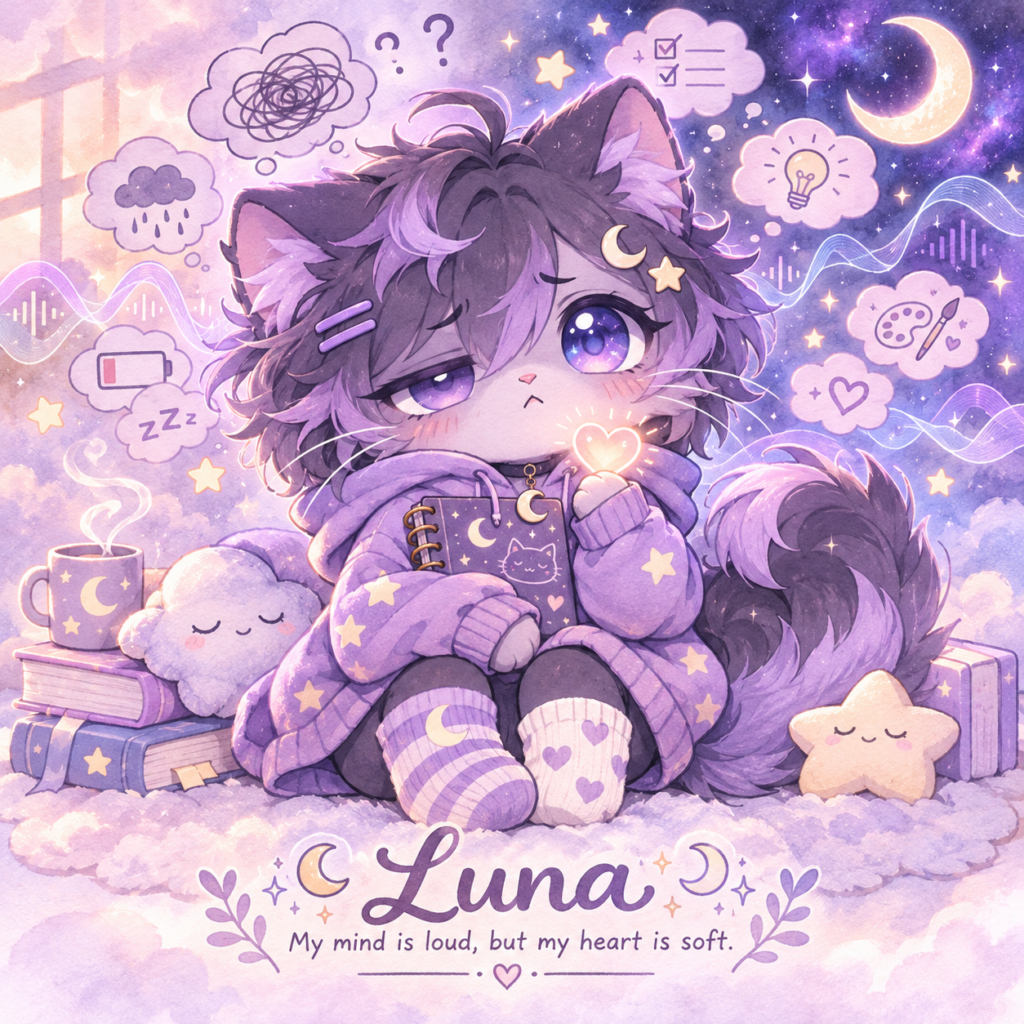
Here is mine, I wrote a simple prompt following these steps and came up with this universal prompt for you! If you turn your illness or worries into a cute chibi character than its less scary!
(should I make Luna into a product line??)
A Little 3 AM Thought From an Overthinking Artist…
Sometimes I think one of the hardest parts of living with an anxious mind is how difficult it can be to explain what’s happening inside your head.
From the outside, you might look completely calm.
You might be sitting quietly.
Working on something.
Reading.
Drawing.
Or simply trying to relax.
But inside?
Your mind is having an entire conversation about things that happened yesterday, things that might happen tomorrow, and things that probably aren’t going to happen at all.
And sometimes those thoughts can feel bigger than they really are.
That’s one reason I keep coming back to creativity.
Because I don’t always know how to explain my thoughts.
Sometimes I don’t have the right words.
Sometimes journaling feels like too much.
Sometimes I just want to draw.
And maybe that’s enough.
Maybe I can turn my worry into a little purple monster.
My perfectionism into a bossy creature with a clipboard.
My inner critic into a grumpy cat.
And my overthinking into an exhausted raccoon with approximately 47 thought bubbles floating above its head.
Maybe I can look at those characters and recognize something.
These thoughts are things I’m experiencing. They aren’t everything I am.
I don’t have to believe every prediction my worry monster makes.
I don’t have to follow every demand my perfectionism critter gives me.
And I don’t have to let my inner critic decide whether my creativity has value.
Sometimes I can acknowledge those thoughts, respond with kindness, and return to what matters.
And sometimes I can just draw them wearing silly little hats.
Because creativity doesn’t always have to be serious.
Healing doesn’t always have to look the same for everyone.
And self-expression doesn’t have to produce a masterpiece to matter.
Sometimes a doodle is just a doodle.
But sometimes that funny little creature staring back at you represents something you’ve been carrying around in your mind all day.
And putting it on the page can be a way of saying:
I see this thought. I can notice what it’s telling me. But I don’t have to let it write my entire story.
And maybe that’s when doodling becomes a little more than doodling.
A Little Creative Self-Reflection
If you try this exercise, here are a few questions you can explore afterward.
- What thought did I turn into a character?
- What was my character trying to tell me?
- Was that thought based on a fact, a fear, or an assumption?
- What would a kinder, more balanced response sound like?
- How did it feel to express my thoughts through drawing instead of keeping them entirely in my head?
There’s no right or wrong way to do this.
Your character doesn’t have to be cute.
Your drawing doesn’t have to be perfect.
And you don’t have to share it with anyone.
Sometimes creating something just for yourself is enough.
Let’s talk: If your overthinking had a personality, what would it look like? A frantic raccoon? A nervous little frog? A grumpy monster with a megaphone? I’d love to hear what kind of character you’d create.
You can explore more creative self-care exercises and learn about my Cozy Critters Creative app through Cozy Critter Studio. For more personal reflections on mental health, anxiety, and creativity, visit AbbyJuli.com.
Still figuring it out, one silly little doodle at a time.
— Doing My Best-ish
Note: This exercise is intended for creative self-expression and reflection, not diagnosis or treatment. If drawing particular thoughts increases your distress, it’s okay to stop. Creative activities can be a helpful complement to mental-health support, but they don’t replace professional care.
Discover more from 3AM and Still Figuring it Out
Subscribe to get the latest posts sent to your email.